Upper Tier or Lower Bowl: Choosing a View
Upper tier or lower bowl seating changes how a match unfolds in your sightline. Compare angle, distance, and obstructions to choose the view that suits you.
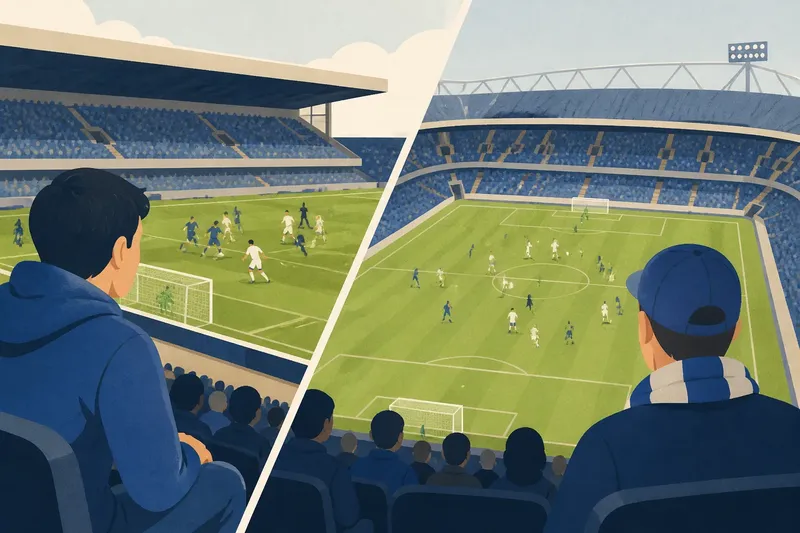
On a stadium seating map, two sections on the same side can look nearly identical, even though one puts the pitch close and the other lifts it into a wider frame. Choosing between an upper tier or lower bowl seat comes down to the view you want: detail near the field or a clearer sense of how play connects across it.
Tier is only part of the decision. A seat’s position along the sideline, its angle toward the field, and possible obstructions can change what you see. Use the venue’s map and any available seat-view images to judge the specific section.
Lower seats bring nearby action forward
From a lower bowl, players appear larger, and nearby gestures or physical contests can be easier to distinguish. If play is in your part of the stadium, the view may feel immediate. But following a quick switch from one end to the other can require more head-turning, and players close to you may obscure distant action.
The lowest rows can also put boards or other pitchside boundaries into the sightline. Check the row and seat angle in a view image if one is available; being closer does not automatically mean seeing more clearly.
Choose a lower seat if close-range movement and the feeling of being near the field matter more to you than seeing the whole pattern at once.
Upper seats make team movement easier to read
From higher up, players look smaller, but their positions can be easier to compare across the pitch. The extra separation may help you follow how teammates move into space while the ball is elsewhere, or see how an attack shifts from one side to the other.
This view can feel less immediate than a lower seat. It also does not guarantee a complete view: a corner position, roof supports, or other obstructions can affect what is visible. Check the section location and any restricted-view notes rather than choosing by tier alone.
Choose an upper seat if you value a broad view of team shape and prefer to follow a sequence across the field.
Seat angle can matter as much as tier
A seat near the halfway line generally faces the field more evenly from end to end. Behind a goal, the same match may look more compressed, with attacks toward that end taking up more of your attention. A corner position gives yet another angle, and nearby rows can differ in what the boards or railings block.
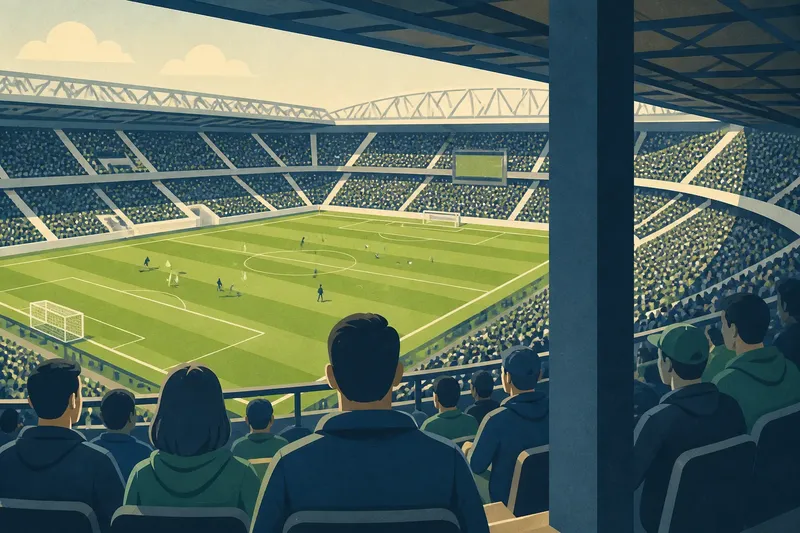
When comparing options, look for the seat’s position relative to the halfway line, the goals, and the field edge. Then check whether the listing or venue map identifies restricted views, rails, barriers, or supports.
- If a seat-view image shows an unobstructed view of both ends, then keep it in consideration; if a support or barrier crosses the main sightline, then compare another row or section.
- If the seat is near the halfway line and you want an even view of both ends, then compare it with other central sections; if you prefer attacks toward one goal to dominate your view, then consider a seat behind that goal.
- If the listing names a restricted view and explains the obstruction, then decide whether that part of the field matters to you; if it is unclear what is blocked, then look for a venue image or choose a clearly described option.
- If nearby play is your priority, then compare lower rows for closeness; if you need to follow action across the pitch, then compare higher rows for a broader angle.
- If a low row places boards or railings across the field edge, then look at a higher row; if the edge remains clear and close detail appeals to you, then the lower row may suit your preference.
- If you are choosing with someone who dislikes frequent head-turning, then compare sections that keep more of the pitch in view; if that person prefers a close perspective, then weigh nearby action more heavily than a full-field overview.
Compare seats against the way you watch
Before choosing, decide whether your attention usually stays on the ball, follows a particular player, or moves between the ball and the wider formation. These preferences can point toward different seats:
- Ball and nearby contests: A lower view can make close action more prominent, though far-side play may be harder to inspect.
- Movement away from the ball: An elevated view can make the spacing between players easier to follow.
- Attacks at one end: A seat behind a goal emphasizes play toward that goal, while distant action may appear less direct.
- A view of both ends: Compare central sections and check the angle rather than assuming any tier provides the same perspective.
Say you are choosing between a lower seat behind the north goal and an upper seat near the halfway line. You want to watch a striker’s runs and how the opposing defense shifts. First, you decide that seeing movement across both halves matters more than close views of nearby players. Next, you check the map and find that the upper seat faces the pitch from near the center, while the lower seat is aimed toward one goal. You review the available view images and see no listed obstruction for either. The upper seat is the better match for your stated preference; if close-range reactions mattered more, the lower seat would be the stronger tradeoff.
How should you compare seats before buying?
Does an upper tier show more of the pitch?
Height can provide a broader view, but the seat’s angle and position still matter. Compare the actual section and check for supports or other obstructions.
Are lower seats better for seeing players?
Nearby players may look larger, and their gestures can be more noticeable. Far-side action can remain difficult to track, especially from a low angle.
Which tier suits a spectator who follows team shape?
An elevated view can make spacing and movement away from the ball easier to compare. A central section may also help keep both ends in context, regardless of tier.
What should you check on the seating map?
Check the seat’s position relative to the halfway line, goals, and field edge, then review any view image and restricted-view notes. If the source does not explain a possible obstruction, compare another section or seek clarification from the venue.
Choose the tradeoff that fits your match
For upper tier or lower bowl seating, start with the experience you want rather than a tier label. A lower seat favors a closer view of nearby play; an upper seat can make movement across the field easier to follow. Then use the section angle and obstruction details to refine your choice.
When two options seem equally appealing, ask which part of the game you would most regret losing from view. That answer can make the tradeoff clearer than the map’s color or tier name.