From Open Ground to Enclosed Stadium
From open ground to enclosed stadium, trace how stands and boundaries frame the field and reveal what remains connected to the surrounding landscape.
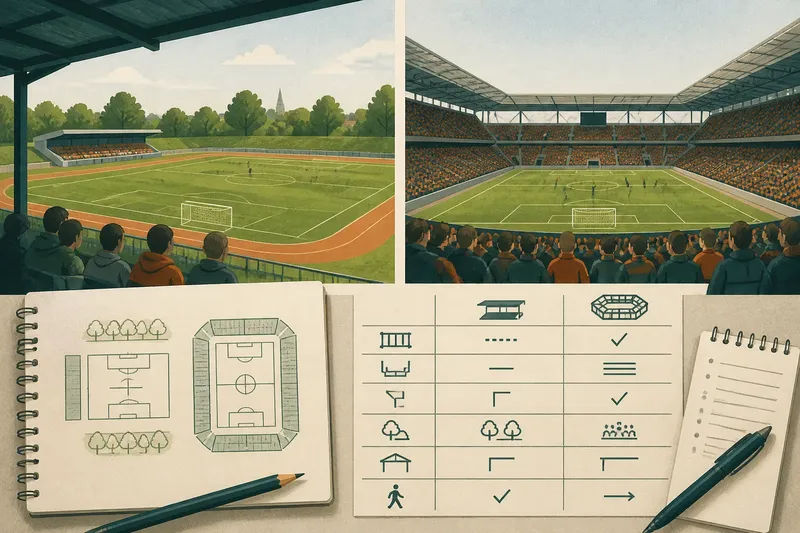
From the open end of a neighborhood football ground, you can see a line of trees beyond the goal; from the stand opposite, the crowd across the field fills much of your view. The shift from open ground to enclosed stadium is a change in how architecture frames the event and connects spectators to the site around it.
Compare a venue in a fixed order: begin at the playing area, follow the boundary through the stands and corners, then look overhead and trace the route from entrance to seat. This makes the design easier to read than judging enclosure by the roof or the number of stands alone.
The field and its boundary set the first frame
An open sporting ground often places the field within a larger visible setting. A track, grass bank, low fence, or simple row of seats may mark where the playing area ends, while paths, trees, neighboring buildings, or sky remain in view beyond it.
Look first at the space between the playing area and the nearest seats. A track or broad strip of grass can separate spectators from play. Seats close to the boundary can make the action feel more immediate, even if the rest of the ground is open. Also note what lies beyond the field: a view of the surrounding site gives the event a different frame from a view of stands on every side.
Say you are comparing two invented football grounds. Ground A has one low stand along a sideline, open grass behind both goals, and trees visible beyond the perimeter. Ground B has seats on every side, with the ends meeting the sideline stands. At each ground, you note whether nearby seats or the landscape occupy more of your view. The resulting comparison is specific: A keeps the field visually connected to its setting; B makes the seating and crowd its dominant frame.
Write down what separates the nearest seats from play, then note what you can see beyond the field.
Stands turn separate edges into a shared enclosure
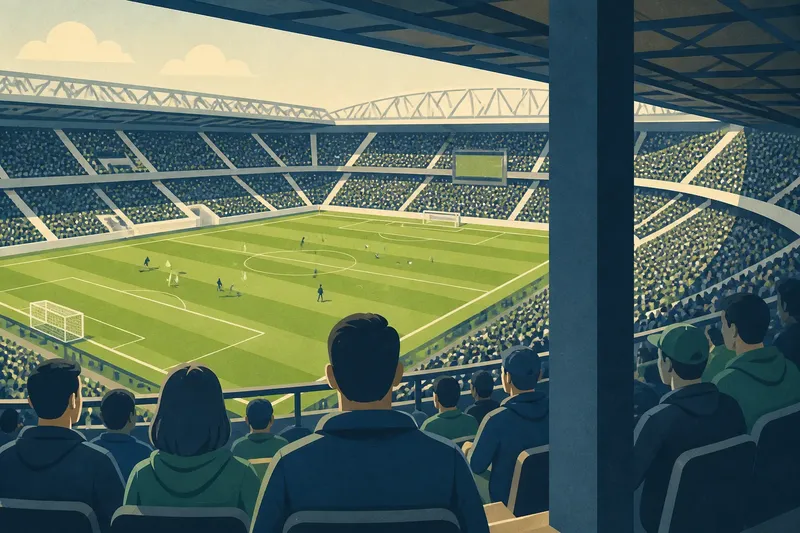
One stand gives spectators a single edge to face from. Opposing stands place crowds in view of one another. Stands joined around the corners can create a more continuous boundary, though openings between sections may keep the ground visually linked to its surroundings.
As you follow the perimeter, distinguish gaps between seating from gaps that reveal the wider site. A corner opening may show sky, buildings, or a path beyond the stands. An opening filled by a stair tower or enclosed concourse may interrupt the seating ring without offering the same outward view.
Imagine a visitor comparing a ground with two facing stands to one with seating joined behind the goals. The visitor checks each corner from the same position. If the first ground reveals open sky and nearby buildings through its corners, the visitor can describe it as visually open at those edges; if the second presents continuous stands, the visitor can describe the field as more fully surrounded. This comparison concerns the visible boundary, not which venue is better.
Follow one edge at a time; the gaps often tell you as much as the stands do.
The roof frames the space above the spectators
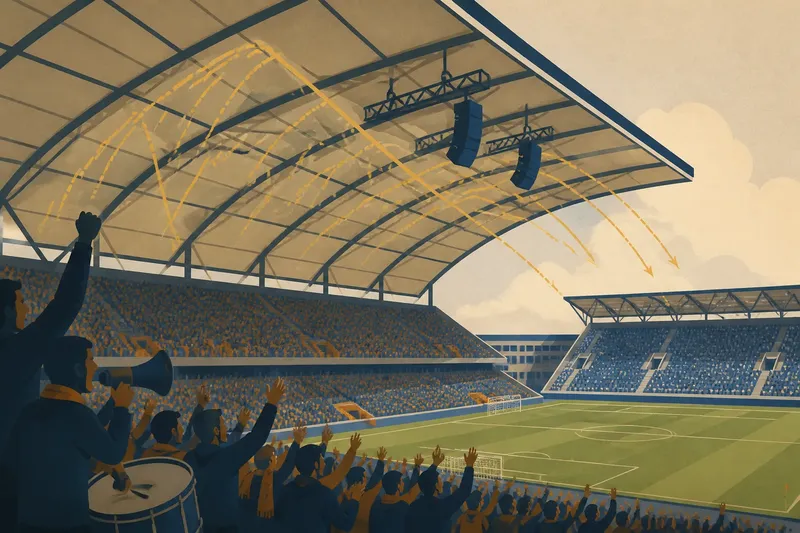
A roof can create a strong boundary overhead even when the sides remain open. A canopy over one stand gives that seating area a distinct ceiling, while a roof extending around the ground can make the event feel more contained. Supporting beams and the roof edge also shape what spectators see when they look up or across the field.
Compare covered and uncovered sections from a similar viewpoint. Note where the roof begins, whether it continues around the ends, and whether the sky remains visible beyond the far stand. A roof may shelter a stand without closing the ground; a continuous roof and connected stands can create a more unified visual frame.
Look up from the seats, then look past the far side of the field. The contrast shows how the roof frames the event and how much of the setting remains in view.
Arrival reveals where the venue begins
An open ground may reveal its playing area from an approach path, while a more enclosed stadium may place gates, stairs, or concourses between the street and the stands. These transitions affect how clearly the venue feels set apart from its neighborhood.
Notice where the field first comes into view. You might see it through an open entrance, from a concourse, or only after reaching the seating area. The sequence helps explain how the building guides attention inward without requiring assumptions about how every visitor will experience it.
If the view opens toward the field before you reach the seats, record that as an early visual connection. If walls or interior routes screen the field until later, record where that separation ends.
Use a consistent comparison to read enclosure
For a useful comparison, use the same observations at each ground. These notes are not scores; each one ties a visible feature to a clear description or next question.
- Check the space between the playing boundary and nearest seats. If a track or broad strip of ground separates them, note that separation; if seats sit close to the boundary, note the closer visual edge.
- Check how many sides have stands facing the field. If only one side is occupied, describe a single-sided boundary; if stands face one another or surround the field, describe the stronger shared frame.
- Check whether the stands meet at the corners. If they meet, note a more continuous seating edge; if gaps remain, look through them and record whether they reveal the site or only building structures.
- Check what is visible beyond the far side of the field. If you see landscape or neighboring buildings, note the connection to the setting; if you see another stand, note that the crowd forms the view’s far boundary.
- Check where the roof starts and ends. If it covers one stand or leaves the ends open, describe partial shelter; if it continues around the seating, describe a more continuous overhead frame.
- Check where the field first appears on the route from entrance to seat. If it is visible early, note an open visual approach; if it appears only after an interior passage, note a more staged arrival.
Imagine comparing two invented grounds for a short design note. At Ground A, the nearest seats are set behind a running track, there is one stand, both ends are open, the roof covers that stand only, and the field is visible from the entrance path. At Ground B, seats face the field from all sides, the stands join at the corners, the roof extends over the seating, and the field appears after an interior concourse. You record A as visually connected to its surroundings and B as more completely framed by the building. The tradeoff is clear: A keeps more of the site in view, while B makes the field and surrounding crowd the dominant scene.
What do people ask when comparing open and enclosed grounds?
Does an enclosed stadium always make the field feel closer?
No. Stands can surround the field visually, but the distance to the nearest seats and the separation between seats and play still matter. An open ground with nearby seating may feel more immediate than a large enclosed venue.
Why do some grounds leave corners open?
Open corners may preserve views through the venue or reflect how its stands and circulation spaces are arranged. Look through the gap to see whether it connects the seating area to the surrounding site.
Can a roof create a sense of enclosure without walls?
Yes. A broad roof can form a visible ceiling over spectators, even if the sides remain open. The views beyond the stands and the amount of sky still visible help distinguish overhead shelter from a fully enclosed frame.
What should I compare first at two stadiums?
Start with the distance between play and nearby seats, then note how many sides have stands and whether the corners are open. Those observations establish the field’s immediate frame before you compare the roof or arrival route.
Enclosure describes a design relationship, not a ranking
Moving from open ground to enclosed stadium does not mean moving toward a universally better form. A more continuous boundary can make the stands and crowd dominate the view; an open edge can keep the event visually connected to weather, landscape, and nearby streets. Which effect matters depends on what the design is intended to frame.
When you compare venues, use the phrase open ground to enclosed stadium to describe a change in boundaries: how the stands meet, what the roof covers, and what remains visible beyond the field. A note about one open corner or one early view of the pitch can explain the character of a ground more clearly than a broad label alone.